Showing posts with label Buddhism. Show all posts

December 12, 2019

Burmese Shan State Tai Yai Jambupati Crowned Buddha Statue

Burmese Shan State Tai Yai Jambupati Crowned Buddha Statue 

Burmese Shan State Tai Yai Jambupati Crowned Buddha Statue

Burmese Shan State Tai Yai Jambupati Crowned Buddha Statue

Burmese Shan State Tai Yai Jambupati Crowned Buddha Statue

Burmese Shan State Tai Yai Jambupati Crowned Buddha Statue

Burmese Shan State Tai Yai Jambupati Crowned Buddha Statue

27 1/2" tall 12" wide.  24K gold gilt, lacquered and mirror inlay circa-1942-1948 hand made in occupied Shan State Burma.  Carved out of Teak wood in Tai Yai style, wearing royal attire and crown. Seated in bhumisparsha mudra.   Crown points removable.  Great condition

For Sale $4275 usd / obo + shipping & insurance

မြန်မာရှမ်းလူမျိုးအသိုင်းအ ၀ ိုင်းမှ Jambupati ဘုရားရှိခိုးကျောင်းတော်မှရောင်းမည်


More items for sale

March 4, 2015

Antique Japanese Meiji Period Cobalt Blue Satsuma Vase Signed Hotoda 保土田 薩摩焼

Antique cobalt blue Satsuma vase   Meiji period   signed Hotoda ( 保土田 ).
Antique Japanese Meiji Period Cobalt Blue Satsuma Vase Signed Hotoda 保土田 薩摩焼

The vase is a six sided panel vase standing 8" tall with an image of 8 Rakan & 3 little girls flanking Kannon
 

Rakan are legendary disciples of the historical Buddha, Shakyamuni. Following his example, they attained enlightenment through their own efforts and they remain in the world to preserve the teachings of Buddha until the coming of the future Buddha, Maitreya.   Kannon is the Japanese name for the Buddhist bodhisattva Kwan Yin, aka Guanyin, the Buddhist bodhisattva of compassion, Avalokiteshvara

Antique Japanese Meiji Period Cobalt Blue Satsuma Vase Signed Hotoda 保土田 薩摩焼Antique Japanese Meiji Period Cobalt Blue Satsuma Vase Signed Hotoda 保土田 薩摩焼Antique Japanese Meiji Period Cobalt Blue Satsuma Vase Signed Hotoda 保土田 薩摩焼


The other side of the vase is a scene of 5 geisha and 3 hangyoku maiko (little girls bonded to the geisha house, in training to become geisha).

Antique Japanese Meiji Period Cobalt Blue Satsuma Vase Signed Hotoda 保土田 薩摩焼

The vase is marked with the signature seal of Hotoda 保土田

Satsuma, Mark of Hotoda 保土田

  Hotoada was a well-known painter of Satsuma wares during the Meiji Period (1868-1912). 
The Hotoda mark is usually associated with some of the best quality wares to bear a Satsuma mark during the Meiji period. 


For Sale:  $3500 usd/ obo + shipping & insurance.

More items for sale

February 15, 2015

Late Meiji Thousand Faces Satsuma Vase Signed Hotoda 保土田

   Meiji period Thousand Faces Satsuma vase,


Thousand Faces Satsuma signed Hodada , aka Hodata, 保多田 Thousand Faces Satsuma signed Hodada , aka Hodata, 保多田


The vase is signed Hotoda , aka Hodota &/or Hododa, etc thanks to the asshats at Gotheborg for perpetuating incorrect information , 保土田.  The correct spelling is HOTODA.  My estimate is that it's dated somewhere around the end of the Meiji period circa 1900 to perhaps early Taisho period 1916.

Hotoda was one of the last great master's of Satsuma during the Meiji period

.    The Thousand Faces design features Kannon, the Japanese Buddhist Bodhisattva of Compassion, aka Kwan Yin / Guanyin, a single male figure which I haven't identified as of this writing, and multiple rakan which are often erroneously referred to as arhat or lohan, and are commonly also referred to collectively as "immortals,  each of them of the same face, and a white dragon intertwines through them.  Rakan, Arhat & Lohan all mean the same thing, but only RAKAN is used in Japanese.  The other terms are Indian and Chinese.

  There are several variations of the Thousand Faces Satsuma design, as well as the Thousand Faces Kutani.  

the wooden stand ise Chinese late Qing Guanxu period to early Republic period.

For Sale:  $800 usd /obo + shipping & insurance


September 3, 2014

Large Japanese Porcelain Kutani Moriage Hotei Statue 九谷布袋

It seems I am once again blessed with good fortune.

       I never know what I'll find when I'm out hunting for Asian art and antiques. Call me obsessed, but I have this compulsion to do so as often as possible whenever I'm financially able to, even if it means scouring the shelves of a thrift store hoping to bring home something unique for super dirt cheap.

  So today was the first day of school and with my daughter gone for the day, I decided to hit up a couple of shops I frequently visit, and, well, I wasn't counting on making any large dollar amount purchases and I hope I'm not going to regret doing so later when I'm sending out checks for my monthly household bills, etc since it appears I have exhausted my available spending funds for the next two weeks.

One of the shops I stopped at is an antiques store which I visit very often, at least once a month.  Today, as I entered the store, the owner, a 90+ year old woman, was just about to step outside.  We began talking, as we customarily do, and she started talking about this large stained glass window that was next to her leaning against the wall by the front door, and that she wants to move it to the other side of the store on the window sill.    I offered to move it for her, and as a result, it appears maybe I got a bargain price on this large Japanese Kutani Hotei statue.

Large Japanese Porcelain Kutani Moriage Hotei Statue 九谷布袋
Hotei ( 布袋 ) is one of the Japanese Shichifukujin 七福神 , The Seven Gods of Fortune, or in Western terms, Seven Lucky GodsHotei is the fat and happy god of contentment, happiness, abundance and good health, also known as Budai or Pu-Tai in Chinese mythology and/or folklore, etc.  In Western culture, he is referred to as the Laughing Buddha even though he is not Buddha, albeit some Buddhist sects consider him to be an incarnation of Maitreya or Miroku Nyorai.

The base of the statue has an incised Kutani mark, 九谷, and is intricately decorated in a Satsuma moriage style.  He is approximately 14" tall and weighs at least 8 to 10 pounds I think.

After I finished moving the large stained glass window, there on the shelf in front of me was a large Satsuma temple vase, which I eagerly and excitedly oohed and aahed over until I saw the "Made in Japan" mark on the bottom.  Sure I liked the vase, but I felt perhaps it was not that old, so I decided perhaps I should not fork over $50 for it, and that's when I turned around and saw what looked like a Satsuma Hotei, yet when I picked it up for a closer look, realized that it was not Satsuma at all, but Satsuma style, because the clay was not an earthenware, nor was there the tell tale Satsuma crackled glaze.  At the time I couldn't even see the marking, because I didn't have my magnifying glass and my eyes are poor these days.   The owner of the shop also has bad eyes, so when she asked me if I could read or see the mark, my answer was "I think I see Made in.. it probably says Made in Japan", and it wasn't until I got home that I saw that it's actually a Kutani mark, 九谷.

 
I put the Hotei statue down and browsed around her shop, picking up a 6 1/2" Satsuma vase with a Samurai decorated in moriage, and a small Chinese saucer with the Shou symbol for longevity, .   After I placed them onto the counter, I went back to examine Hotei, hoping it was within my budget and I asked the owner, "how much is he?"   Her answer was "since you helped me, you tell me what it's worth to you".   I was hesitant, because I didn't want to sound cheap, although I'm certain she knows all too well that I'm always looking for bargains as I've haggled with her 90% of the time I have ever made a purchase from her, but also, at the same time, I knew I only had $40 in my pocket, so, without thinking of the other two items I also wanted, I said "I only have $40 in my pocket" to which she said "sold..  I'll give it to you for that price" which pleased me very much even though I knew I would be broke until I get paid again.

When I got to the counter to pay, that's when I realized I didn't have enough to pay for the other two items, however, she trusted that I would come back and pay, so allowed me to take them home on the promise that I would return, which of course I will, because I have known this woman for over a year now and have been in her store at least several dozen times, as well as see her around town in other shops, etc.. even at a local auctioneer's hall, so, and besides, she also knows my name and where I live, so yes, of course she trusts me.

I immediately began Googling around trying to determine how old this Kutani Hotei is, as well as its potential value, and I'm coming up with various possibilities for its age, from late Meiji to early Taisho, even early Showa, so my research is incomplete and its age remains uncertain at this time.

  As for value, well, that's a real crap shoot, because all I have to go by are eBay listings, and, well, sorry to say, but the majority of sellers on eBay don't know their freaking ass from their elbow, never mind the age and values of Japanese porcelain and antiques, etc.  They pretty much pull numbers out of thin air, like one particular delusional fool from Seattle who thinks her Kutani Hotei is worth $950 + shipping.   I say good luck with that as I laugh at how absurd her asking price is.  I have seen others ranging from $50 up to $300+, all with differences, none of them the size of this one, except the $950 one and another I found for $875, so who knows... Maybe it is worth that much, yet I seriously doubt that.   The majority of the Japanese Kutani Hotei figures and statues I saw selling online were all in the 6" to 8" range with the exception of 2, and none quite the same, although a little similar.  I am happy however that mine seems to be in far superior condition and detail than the ones I saw online.

Another major difference I noticed, is that most of those that are marked have the Kutani mark 九谷 painted in red while the marking on mine is incised into the clay.

Large Japanese Porcelain Kutani Moriage Hotei Statue 九谷布袋 Large Japanese Porcelain Kutani Moriage Hotei Statue 九谷布袋

August 17, 2014

Japanese Double Fish Wood Sculpture Made by Ōkawa Kōtarō 幸古郎 作 幸野 氏

Not too long ago I wrote about a Chinese auspicious double fish wind chime I found in a local second hand resale shop, and today I'd like to share with you a Japanese double fish wood sculpture I just found a few days ago.

   Ironic that the double fish symbol is an auspicious symbol, because I literally just found this out of nowhere.  I was walking home with my daughter when I saw a plastic bin full of old photo albums next to trash barrels.   Curious about what else may be in the bin, I decided to take a look, against the objections of my daughter who whined at me "oh my god!. It's just old junk.  There's nothing Chinese in it".   Well, lo and behold, to my delight, and bewildered at this odd coincidence, I happily responded back to her "Yes there is, see" as I pull out and hold up this Japanese wood sculpture of double fish mounted on a tree wood slice.

It appears I have been blessed with good fortune. :)


Japanese double fish wood sculpture by Ōkawa Kōtarō 幸古郎 作  幸野 氏 Japanese double fish wood sculpture 幸古郎 作  幸野 氏


        At the time, when I initially found it, I assumed it to be Chinese, however, having asked my friend Hung in Taiwan for a translation, it turns out that it is Japanese.   The calligraphy text reads 大川 幸太郎, which translates as being made by Master Ōkawa Kōtarō 幸野 氏,

Okawa Kotaro is a traditional wood carver who specialises in Buddhist statuary. He lives and works in the Shitamachi neighbourhood of Tokyo, Asakusa.  He is the author & subject of the book "How to Make Wood Carving of Buddha: Gentle Buddhist Image Maker in Pictures"

July 25, 2014

Why is There a Hole Instead of a Hand? The Mystery of Kwan Yin's Missing Hand.

As a Mahāyāna Buddhist, I have a particular fondness for Guanshiyin, the Buddhist Goddess of Compassion & Mercy, aka Guanyin, Kwan Yin, etc.   Consequently, when I'm out shopping or browsing online auctions sites, one of the items I often look for are porcelain Kwan Yin statues, and nearly every single time I have found one in a shop, it was missing a hand, and instead of a hand, there was a hole where Kwan Yin's hand should be.  Even online I have seen a few where Guanyin has a missing hand.

At the time, this perplexed me and I incorrectly assumed that the statue was broken, therefore did not purchase it.  In retrospect, perhaps I should have bought it anyway, and so today I ended up buying a porcelain Kwan Yin statue with a missing hand..

I visited a local auction today and among the items I purchased was this white porcelain Kwan Yin statue, painted with gold gilt decoration and it is for this reason that I am writing this post, because the porcelain Kwan Yin statue is missing a hand, unlike the new ceramic Kwan Yin statue I purchased last week from a local Chinese gift shop, and although that one does not have a missing hand, it is detachable, so I wondered why does Kwan Yin's hand come off like that.


White Porcelain Gold Gilt Decorated Kwan Yin Statue with Missing HandModern Chinese Ceramic Kwan Yin Statue with Detachable Hand


I did a little bit of research and learned, according to Chinese tradition, Kwan Yin will literally "lend a hand" to those in dire need, which is why the statue's hand is removable. .In another version,  the owner of the statue would pray to Kwan Yin and make a request for healing, etc and would then carry Kwan Yin's hand until the prayer is granted and then return the hand back to the Goddess of Compassion.    In yet another version, Kwan Yin's hand is removed and hidden somewhere in the home and as long as Kwan Yin looked for her hand there would be good luck in the home, so clearly it's not unusual to see a porcelain Kwan Yin statue with a missing hand.

In an excerpt from Discovering Kwan Yin, Buddhist Goddess of Compassion By Sandy Boucher, the author states the following:

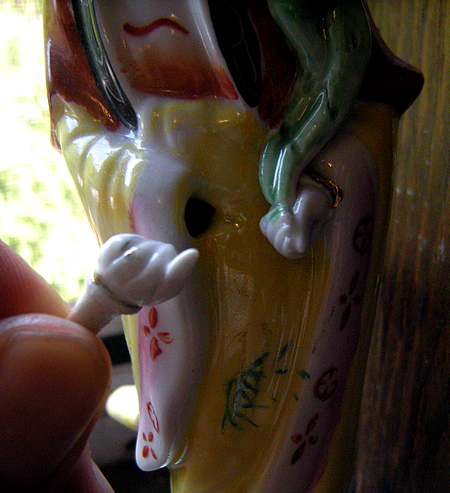
Kwan Yin Statue Detachable Hand RemovedSome of the small white ceramic statues of the white robed Kwan Yin have a detachable hand that can be pulled out of the sleeve of her robe.        
     The belief is that when you want something, you petition Kwan Yin.  Then you take the small white hand and hide it somewhere in your house. Kwan Yin, presumably, is so distressed at losing her hand that she will grant you your wish.  Then when your desire has been granted, you find the little hand and replace it on the statue.


Porcelain Kwan Yin Statue Base & Makers Mark of Crown & Sword
Personally, I'd much rather my own porcelain Guanyin statues did not have a missing hand.

Regardless of the fact that my newly purchased ceramic Kwan Yin statue is missing a hand, I like it very much, however, I am perplexed by the maker's mark since it is not one I am familiar with and I am very doubtful that it belongs to a Chinese maker or artist since I have never seen a Chinese maker's mark that has a crown.  Perhaps it is Japanese since there are many Japanese porcelain marks that contain a crown.

If this is Japanese made, then it would more appropriately be a ceramic statue of Kannon or Kanzeon since that is the Japanese name for Kwan Yin.

 If anyone reading this post is familiar with this crown and sword maker's mark on my statue, please let me know.

Thank you.

June 26, 2014

One of a Kind Hand Made Chinese Buddhist Auspicious Double Fish Wind Chime

  Here's an interesting art object I found earlier this week.  Based on the fact that it hangs and has two Buddhist bells at the bottom, my only conclusion is that it's most likely a wind chime.   The overall look and appearance looks like Tibetan hand craft to me, however, the writing on the double fish as well as on the Buddhist bells is Chinese and I'm not sure at this point if that rules out the possibility of this artwork being Tibetan hand craft.

Hand Made Chinese Buddhust Auspicious Double Fish Wind Chime


The bodies of the double fish are made of leather, which are framed by vegetable dyed wood and/or seed based beads.   Both sides of the fish bodies are painted and have Chinese writing on them, which I haven't had translated yet.  One side is written in regular script, the other in symbols which appear to be akin to oracle bone script.   One one side, seen in the photo above, the double fish's bodies are painted pink and red, with bright green tails.  On the opposite side, shown in the photo below, the double fish have bright green bodies and bright red/pink tails.

Hand Made Chinese Buddhust Auspicious Double Fish Wind Chime

 I am doubtful that this "Buddhist" double fish "wind chime" is that old due to the colors used in the paint, however, according to a website called "Something Awful", neon colors were invented in the nineteenth century.   My best guess is that this piece is most likely late 20th century and is a one of a kind hand crafted item by a Chinese artisan, however, I know nothing whatsoever of its origins or who made it.

I'd love to know what the text says, so if anyone reading this post reads Chinese, I'd greatly appreciate your help.

Here's some close up, detail photos of the double fish:

Hand Made Chinese Buddhust Auspicious Double FishHand Made Chinese Buddhust Auspicious Double Fish

Hand Made Chinese Buddhust Auspicious Double Fish Hand Made Chinese Buddhust Auspicious Double Fish

It wasn't until I got home after purchasing this and looked at the bells with a magnifying glass that I noticed the Buddha and the inscriptions on the bell and it's unlikely I'll be able to get a translation for the inscription on the bell until I can provide better photographs of the Buddhist bells.

One of the bells, unfortunately, is now nothing more than a broken, jagged, Chinese puzzle since just now as I was writing this post, I began re-examining it again to get a feel for what type of metal it is in order to better describe it, and as I gently squeezed, it shattered into multiple fractured pieces, which rules out bronze or brass and confirms my assumption that the bells are made of cheap, crappy pot metal.   Neither of the two bells had a clapper.  Whether or not they originally had one, I do not know, but looking inside the remaining bell that's still intact, it appears very likely.

I'm very disappointed about the bell being broken and am not confident I will be able to piece it back together, so suppose I should begin looking for a replacement, preferably a pair.

Here's photos of the Chinese Buddhist bells that hang on the bottom of the double fish wind chime, along with my new Chinese puzzle. :(.

Chinese Buddhist bellChinese Buddhist bellChinese Buddhist bellChinese Buddhist bellChinese Buddhist bellChinese Buddhist bellChinese Buddhist bellChinese Buddhist bellChinese Buddhist bellBroken Chinese Buddhist bell puzzle

After discovering the Buddhist bells on the double fish "wind chime", I learned that the double fish symbol has some significance in Buddhism, as well as Chinese Feng Shui and folklore, however, in these, the double fish are golden, which is not the case for my double fish wind chime, so I'm a bit perplexed about this.

Insofar as double golden fish go, in Tibetan Buddhism, the golden double fish symbol is one of the Eight Auspicious Symbols.   

These have their origins in the two sacred rivers of India the Ganges and the Yamuna. Symbolically, these rivers signify the lunar and solar channels of the human body, originating in the nostrils and carrying the alternating rhythms of breath, or chi, also known as prana. So the golden fishes bring life and happiness. They represent fertility and abundance as they multiply rapidly. Fish often swim in pairs, and in China, a pair of fish signifies conjugal fidelity and unity.

Giving a pair of fish as a wedding present is regarded as very auspicious. This signifies a fervent wish for the couple to find happiness together and be blessed with many children. The Chinese word for fish yu also means great wealth, so material prosperity is also wished for the couple.

The fish used in the symbolism here is usually the carp, which is regarded as sacred to many Asian cultures because of its beauty, its size and its long lifespan. In India and Tibet, the golden carp is regarded as being exceptionally auspicious. Even in ancient Egypt, a pair of fish is regarded as a sacred icon as it symbolizes the life - bringing waters of the River Nile. Having fish in one’s home especially in pairs is thus very auspicious.

In general, The golden fish symbolizes the auspiciousness of all living beings in a state of fearlessness, without danger of drowning in the ocean of sufferings, and migrating from place to place freely and spontaneously, just as fish swim freely without fear through water.

The Symbolism of Double Fishes in Chinese Culture, and Feng Shui

In feng shui and for oriental traditions, the fish is a very symbolic creature which represents abundance and wealth. Having fishes in the kitchen is a great way of helping abundance and provisions to be always present in the house. Feng shui practitioners recommend having fishes and double fishes in the kitchen or the living room in order to make sure that those who inhabit the house will always have what they need.

Yu, which means fish, phonetically matches the word for abundance, which might be a coincidence but is very symbolic as well. It is very common to see objects representing fishes in many Chinese houses, most of the times in the kitchen but sometimes in the living rooms as well.

Fishes are abundant in the sea and provide us an unlimited source of nourishment and supplies. It is a natural source of human sustenance which can be found in abundant amounts. Therefore, they are an abundant creature itself and its symbolism might be highly due to this aspect of their nature.

Besides all what was mentioned above, a fish is also seen as a symbol of fertility. Fishes have notable abilities for reproduction which makes them an ideal icon for symbolizing fertility. They are always together and travel as a team which makes them also symbolize unity and marriage.

A fish is also a symbol of life renewal. This creature survives all times and époques and is always there for other beings to nurture from them. They are constantly renewing and giving birth to next generations, and this is seen by the oriental cultures as a great symbol of life preservation and regeneration. They show strength and are seen as representing a power for restoration and revival as well as rejuvenation and the power of continuation through time.

Double fishes represent unity, marriage and abundance not only in food provisions but also in children and family in general. Having double fishes in the living room or the room in which the family gathers to eat is a great way of assuring abundance in all aspects and for all the family members.


Fish in Buddhism:

In an article titled Wooden fish gongs and wind chimes: Symbols of Buddhist cultivation, author Chun Ock-bae states that "The origin of the use of the fish in Buddhism is unknown: one version tells that a fish always has its eyes open day and night; thus it is a reminder to always be aware."

Further on in the article, after discussing Moktak, he discusses fish wind chimes.

"Fish wind chimes are found on the eaves of Buddhist halls and pagodas. The wind rings the chimes, awakening the monks and nuns. Practitioners, like the fish who are always aware in the sea, practice to continuously cultivate themselves, even in their dreams. The wind in the chimes is likened to the condition of complete freedom from obstruction.

The fish adorning temples is not only a metaphysical symbol of tranquility and unrestricted freedom; it also a character in Buddhist fables. An example of this can be found in the Jatakas, the stories of the Buddha's previous lives as follows:

In one of his former lives, Sakyamuni Buddha followed bodhisattva practices while dwelling in the sea. There he witnessed a large fish preying on smaller ones, which in turn, did the same with still smaller ones. So Sakyamuni caught and ate the biggest fish, sparing the life of the small fish. This Sakyamuni's soul was transformed into the king of the ``makaras'' (a mythical animal with the trunk of an elephant, the front legs of a lion, and the body of a crocodile) with a massive body measuring several ``li'' (a distance of about 400 meters). At that time, famine had struck the land by the sea and people were turning to cannibalism. A huge makara, Sakyamuni beached himself on the shore and offered himself up as food, thereby saving the people from starvation."

Whether or not if any of the above is applicable to the double fish wind chime I have, I am not sure, but it is interesting to learn about nonetheless since I find these sorts of things enlightening, fascinating, and interesting.

If anyone reading this could tell me more about my double fish wind chime, or help with translation, etc, feel free to comment below.

Thank you.

June 23, 2014

Antique Chinese Carved Stone Buddha Head Statue, Or Not?

Antique Chinese Carved Stone Budda Head Statue
Not only do I collect Buddhist statues, figurines and other Buddhist relics, etc, but I also happen to also be Buddhist, although I do also follow the philosophies of Confucianism and Taoism as well, however, for the most part, I consider myself a secular Buddhist, although I do regularly chant many mantra while meditating, such as om mani padme hum, and nam myoho renge kyo, etc..   I have only been on this path actively and seriously for the last 16 months now, however, did previously consider and question Buddhism, so I am still learning more and more each day and haven't yet decided on any specific tradition, sect, etc although I am leaning more towards those of Mahayana traditions even though Esoteric and other schools are appealing.  I find various aspects of many forms of Buddhism fascinating, therefore, have not been able to settle for just one single form.  I initially began exploring Soto Zen, but shortly thereafter progressed to Mahayana.


.   For the past year now I have been wanting a carved stone Buddha head, but could not find any locally.    Certainly there's an abundance of them available online, yet they tend to be pricey, and often I get the feeling that the seller or dealer is making very deceptive claims in order to inflate their selling price.   I for some reason chose not to buy one online, something I rarely do anyway, because I would much rather see the item in person when making a purchase.

So, yesterday afternoon I went out on a treasure hunt and visited some antique shops to see what I could find, and among the few items I purchased was this carved stone Buddha head statue, however, can I assume it's an antique just because it came from an antiques store?  Afterall, the dealer had no freaking clue, as usual, how old it was, nor anything else specific about it, other than "it's Chinese"... and considering the fact that he had about a half dozen of them, all of them very similar to each other,  perhaps maybe they're not really that old.   I honestly don't know.

Antique Chinese Carved Stone Budda Head StatueAntique Chinese Carved Stone Budda Head Statue

Antique Chinese Carved Stone Budda Head StatueAntique Chinese Carved Stone Budda Head Statue

Antique Chinese Carved Stone Budda Head Statue


The carved stone Buddha head stature is 5 1/2" high and weighs a few pounds.  I don't know the exact weight since I do not have a scale, but it feels like at least a few pounds, maybe up to 5;bs, but that's just a guess.


  So, wanting to know the going price for these carved stone Buddha head statues and trying to figure out how old my carved stone Buddha head might be, I began looking around, because I'm very curious by nature, I love learning, and need to know as much as I can about each and every piece in my collection.


I was shocked to see one very similar to mine on eBay with a buy it now of $799, and it's nearly identical to the one I have.   The seller says it is made of Chinese Schist stone, a mixture of quartz and gray stone.  Whether he is correct or not, I have no idea, but I'm curious to know whether or not mine is also Schist stone, and if not, what kind of stone is it?.    On this particular listing for the carved stone Buddha head, the seller claims it is 18th century Qing dynasty and claims it is from 1750s to early 1800s.. and then he claims it is an "uncommon piece",  yet, if uncommon, why did I find at least 6 nearly identical ones in a single store, and then there's another nearly identical one from in eBayer located in China, claiming it to be "old" and selling for $129, and then there's a US based eBayer who has sold multiple carved stone Buddha heads, and has a currently active listing for another one at $39.49 with free shipping, and it's listed as being "new".

  So, the question is, is my carved stone Buddha head an antique or not?  Come to think of it, is it actually carved, or is it possible to be cast from mold using some form of liquid stone mix that hardens much like how concrete works?  How exactly does one even determine the age and or period of carved stone anyway?  I have no idea, nor do I particularly care, well I do, sort of, but the most important thing for me was to have a stone Buddha head, regardless of how old it is, and that's what matters to me....  but I'd still like to know if it's an antique or not, because if it is, I'd possibly consider buying the other 5 for resale considering the prices some of them are listed for, or even to use as trading for other antiques, etc... but more important than that is to document its age and value etc for my future estate since everything I own will be left to my daughter.

Here's the carved stone Buddha heads on eBay that I refer to in this post:
Antique Chinese Carved Stone Budda Head Statue Antique Chinese Carved Stone Budda Head StatueChinese Carved Stone Buddha Head