Showing posts with label Guanyin. Show all posts

March 4, 2015

Antique Japanese Meiji Period Cobalt Blue Satsuma Vase Signed Hotoda 保土田 薩摩焼

Antique cobalt blue Satsuma vase   Meiji period   signed Hotoda ( 保土田 ).
Antique Japanese Meiji Period Cobalt Blue Satsuma Vase Signed Hotoda 保土田 薩摩焼

The vase is a six sided panel vase standing 8" tall with an image of 8 Rakan & 3 little girls flanking Kannon. 
 

Rakan are legendary disciples of the historical Buddha, Shakyamuni. Following his example, they attained enlightenment through their own efforts and they remain in the world to preserve the teachings of Buddha until the coming of the future Buddha, Maitreya.   Kannon is the Japanese name for the Buddhist bodhisattva Kwan Yin, aka Guanyin, the Buddhist bodhisattva of compassion, Avalokiteshvara

Antique Japanese Meiji Period Cobalt Blue Satsuma Vase Signed Hotoda 保土田 薩摩焼Antique Japanese Meiji Period Cobalt Blue Satsuma Vase Signed Hotoda 保土田 薩摩焼Antique Japanese Meiji Period Cobalt Blue Satsuma Vase Signed Hotoda 保土田 薩摩焼


The other side of the vase is a scene of 5 geisha and 3 hangyoku maiko (little girls bonded to the geisha house, in training to become geisha).

Antique Japanese Meiji Period Cobalt Blue Satsuma Vase Signed Hotoda 保土田 薩摩焼

The vase is marked with the signature seal of Hotoda 保土田

Satsuma, Mark of Hotoda 保土田

  Hotoada was a well-known painter of Satsuma wares during the Meiji Period (1868-1912). 
The Hotoda mark is usually associated with some of the best quality wares to bear a Satsuma mark during the Meiji period. 


For Sale:  $3500 usd/ obo + shipping & insurance.

More items for sale

February 15, 2015

Late Meiji Thousand Faces Satsuma Vase Signed Hotoda 保土田

   Meiji period Thousand Faces Satsuma vase,


Thousand Faces Satsuma signed Hodada , aka Hodata, 保多田 Thousand Faces Satsuma signed Hodada , aka Hodata, 保多田


The vase is signed Hotoda , aka Hodota &/or Hododa, etc thanks to the asshats at Gotheborg for perpetuating incorrect information , 保土田.  The correct spelling is HOTODA.  My estimate is that it's dated somewhere around the end of the Meiji period circa 1900 to perhaps early Taisho period 1916.

Hotoda was one of the last great master's of Satsuma during the Meiji period

.    The Thousand Faces design features Kannon, the Japanese Buddhist Bodhisattva of Compassion, aka Kwan Yin / Guanyin, a single male figure which I haven't identified as of this writing, and multiple rakan which are often erroneously referred to as arhat or lohan, and are commonly also referred to collectively as "immortals,  each of them of the same face, and a white dragon intertwines through them.  Rakan, Arhat & Lohan all mean the same thing, but only RAKAN is used in Japanese.  The other terms are Indian and Chinese.

  There are several variations of the Thousand Faces Satsuma design, as well as the Thousand Faces Kutani.  

the wooden stand ise Chinese late Qing Guanxu period to early Republic period.

For Sale:  $800 usd /obo + shipping & insurance


July 25, 2014

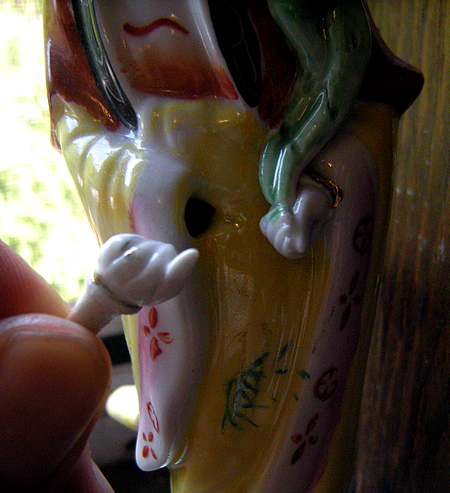
Why is There a Hole Instead of a Hand? The Mystery of Kwan Yin's Missing Hand.

As a Mahāyāna Buddhist, I have a particular fondness for Guanshiyin, the Buddhist Goddess of Compassion & Mercy, aka Guanyin, Kwan Yin, etc.   Consequently, when I'm out shopping or browsing online auctions sites, one of the items I often look for are porcelain Kwan Yin statues, and nearly every single time I have found one in a shop, it was missing a hand, and instead of a hand, there was a hole where Kwan Yin's hand should be.  Even online I have seen a few where Guanyin has a missing hand.

At the time, this perplexed me and I incorrectly assumed that the statue was broken, therefore did not purchase it.  In retrospect, perhaps I should have bought it anyway, and so today I ended up buying a porcelain Kwan Yin statue with a missing hand..

I visited a local auction today and among the items I purchased was this white porcelain Kwan Yin statue, painted with gold gilt decoration and it is for this reason that I am writing this post, because the porcelain Kwan Yin statue is missing a hand, unlike the new ceramic Kwan Yin statue I purchased last week from a local Chinese gift shop, and although that one does not have a missing hand, it is detachable, so I wondered why does Kwan Yin's hand come off like that.


White Porcelain Gold Gilt Decorated Kwan Yin Statue with Missing HandModern Chinese Ceramic Kwan Yin Statue with Detachable Hand


I did a little bit of research and learned, according to Chinese tradition, Kwan Yin will literally "lend a hand" to those in dire need, which is why the statue's hand is removable. .In another version,  the owner of the statue would pray to Kwan Yin and make a request for healing, etc and would then carry Kwan Yin's hand until the prayer is granted and then return the hand back to the Goddess of Compassion.    In yet another version, Kwan Yin's hand is removed and hidden somewhere in the home and as long as Kwan Yin looked for her hand there would be good luck in the home, so clearly it's not unusual to see a porcelain Kwan Yin statue with a missing hand.

In an excerpt from Discovering Kwan Yin, Buddhist Goddess of Compassion By Sandy Boucher, the author states the following:

Kwan Yin Statue Detachable Hand RemovedSome of the small white ceramic statues of the white robed Kwan Yin have a detachable hand that can be pulled out of the sleeve of her robe.        
     The belief is that when you want something, you petition Kwan Yin.  Then you take the small white hand and hide it somewhere in your house. Kwan Yin, presumably, is so distressed at losing her hand that she will grant you your wish.  Then when your desire has been granted, you find the little hand and replace it on the statue.


Porcelain Kwan Yin Statue Base & Makers Mark of Crown & Sword
Personally, I'd much rather my own porcelain Guanyin statues did not have a missing hand.

Regardless of the fact that my newly purchased ceramic Kwan Yin statue is missing a hand, I like it very much, however, I am perplexed by the maker's mark since it is not one I am familiar with and I am very doubtful that it belongs to a Chinese maker or artist since I have never seen a Chinese maker's mark that has a crown.  Perhaps it is Japanese since there are many Japanese porcelain marks that contain a crown.

If this is Japanese made, then it would more appropriately be a ceramic statue of Kannon or Kanzeon since that is the Japanese name for Kwan Yin.

 If anyone reading this post is familiar with this crown and sword maker's mark on my statue, please let me know.

Thank you.

June 7, 2014

Faux Ivory Asian Empress Celluloid Statue

There's a local antiques shop I visit once in a while, however, it is a rare occasion when I purchase anything from this particular shop because her prices are astronomically high and in my opinion, are more than the item's actually worth or would realize at auction.  

Over the past year, each time I visited, I pondered over whether or not to purchase this faux ivory celluloid statue, or perhaps figurine would be a better word since it's only 13 3/4" high, and each time I passed on it due to the price.

I have a particular affinity for the Buddhist bodhisattva of compassion Guanyin, aka Kwan Yin, and thought perhaps this statue was a Japanese representation of her, so I haggled with her since I was not willing to pay her $50 asking price, yet did want the statue, so offered her $25 for it and she obliged, however, after purchase and doing some research, it appears that the figure is not of Kwan Yin, but an empress, or empress dowager.

  I thought this celluloid statue could be Kwan Yin because she stands on a lotus, something that's traditionally associated with Buddhist icons, and also that her left hand appears to be in Abhaya mudra, yet, the fact that she bears a wrapped gift has thrown me off since I have never seen, nor ever heard of any representations of Guanyin carrying a wrapped gift, nor is there any similar symbolism in Buddhism that I am aware of, so that concludes that the figure is not of Kwan Yin, but of an empress.    Having done a little further research, I believe I have the answer as to why this figure stands on a lotus, and that is because many past empresses have become Buddhist nuns after their tenure as empress.

I originally thought the statue was Japanese in origin, but having asked around for assistance in identifying and translating the marks, it appears that it may not be Japanese.   One source told me that it's sloppy and a mess, making it difficult to translate, and another via Asian Art Forums, one of those self proclaimed "expert" types with no credibility claims that it's fake Japanese writing, so, as a result, I'm unable to determine its origins.  Not that he may not be correct, just the manner in which it was stated, which appeared hostile to me, and the fact that he has no history on the forum other than one similar hostile comment to another user.

Maybe it's Korean, or perhaps Chinese, or even European made as another user in another post on Asian Art Forums thinks it was made in Italy, although that possibility raises yet another question, if so, why would they put "fake" Japanese writing on it.  Perhaps the person carving the mold was illiterate, or perhaps it's the maker's "style", although very unlikely.

This celluloid statue leaves me with so many unanswered questions, nevertheless, I do like the piece very much, regardless of its age or origins.

The statue is affixed to a painted ceramic base, has a 2 character marking on the back that appears to look similar to でが, translated as dega(s), yet makes no sense whatsoever, and the strokes are way off, so I seriously doubt that's what it is. On the bottom is another marking, which nobody has been able to decipher.

I believe it's 1920s - 1940s.

If anyone reading this has answers for me, please do comment.

Faux Ivory Asian Empress Celluloid Statue


Faux Ivory Asian Empress Celluloid Statue

Faux Ivory Asian Empress Celluloid Statue

pp 27 est?