Showing posts with label Chinese Ceramics. Show all posts

December 18, 2019

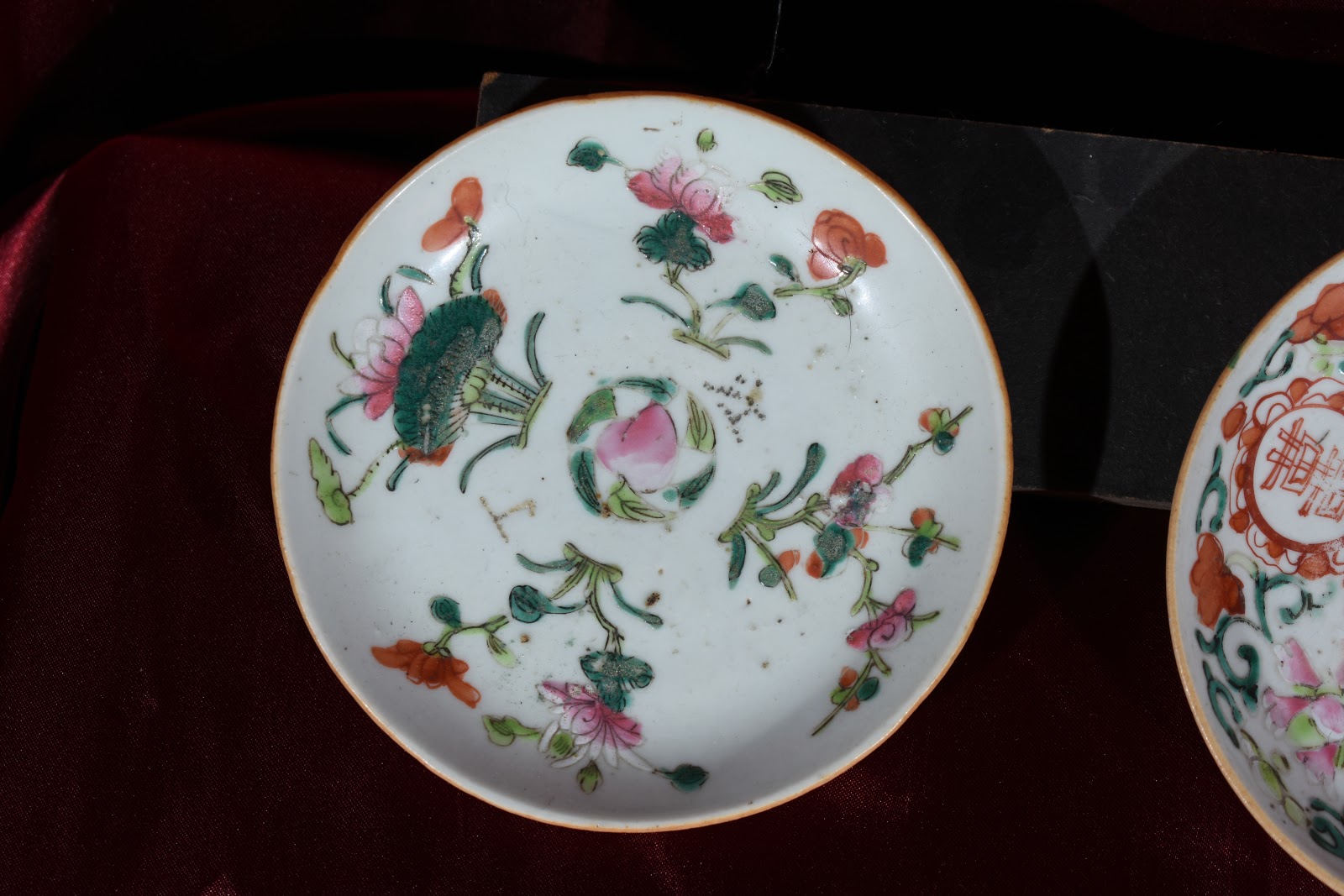
Antique Chinese Qing Dynasty Rose Medallion Plates For Sale

Antique Chinese Rose Medallion Plates For Sale.  
Late Qing  Dynasty to Early Republic Period, circa 1890-1920. 
7.5", very good condition.   $60 usd /obo + shipping & insurance


Antique Chinese Qing Dynasty Rose Medallion Plates For Sale

Antique Chinese Qing Dynasty Rose Medallion Plates For Sale

Antique Chinese Qing Dynasty Rose Medallion Plates For Sale

Antique Chinese Qing Dynasty Rose Medallion Plates For Sale

Antique Chinese Qing Dynasty Rose Medallion Plates For Sale

More Items For Sale

Antique Qing Dynasty Chinese Porcelain Rose Medallion Saucers

 Antique Qing Dynasty Chinese Porcelain Rose Medallion Saucers Tongzhi - Guangxu period

1 round, 1 six-sided. No chips or cracks. Good used condition. Some light fading. Minor pits 1850s-1890s ,approx 5.5" dia $70 usd /obo + shipping & insurance.

 Antique Qing Dynasty Chinese Porcelain Rose Medallion Saucers Tongzhi - Guangxu period

 Antique Qing Dynasty Chinese Porcelain Rose Medallion Saucers Tongzhi - Guangxu period

 Antique Qing Dynasty Chinese Porcelain Rose Medallion Saucers Tongzhi - Guangxu period

 Antique Qing Dynasty Chinese Porcelain Rose Medallion Saucers Tongzhi - Guangxu period

 Antique Qing Dynasty Chinese Porcelain Rose Medallion Saucers Tongzhi - Guangxu period

 Antique Qing Dynasty Chinese Porcelain Rose Medallion Saucers Tongzhi - Guangxu period

More items for sale

Antique Qing Dynasty Chinese Porcelain Daoguang - Tongzhi Period Saucers

Antique Daoguang -Tongzhi period Qing dynasty 1800s- 1875 Chinese porcelain saucers. Fair condition. No chips or cracks. Fading paint, pitting.   Endless knot mark.

 SOLD


Antique Qing Dynasty Chinese Porcelain Daoguang - Tongzhi Period Saucers

Antique Qing Dynasty Chinese Porcelain Daoguang - Tongzhi Period Saucers

Antique Qing Dynasty Chinese Porcelain Daoguang - Tongzhi Period Saucers

Antique Qing Dynasty Chinese Porcelain Daoguang - Tongzhi Period Saucers

Antique Qing Dynasty Chinese Porcelain Daoguang - Tongzhi Period Saucers

Antique Qing Dynasty Chinese Porcelain Daoguang - Tongzhi Period Saucers

Antique Qing Dynasty Chinese Porcelain Daoguang - Tongzhi Period Saucers

More items for sale

November 10, 2014

Cao Rui Ying Yixing Zisha Teapot - 曹瑞英制 宜兴紫砂壶

   During one of my recent treasure hunts looking for Asian art, I found another Yixing Zisha clay teapot, made by Cao Ruiying, marked with a seal on the bottom that reads 曹瑞英制, Cáo ruì yīngzhì, made by Cao Ruiying.  There's another mark under the lid with a simple mark for Ruiying, 瑞英..  I'm not sure if Ruiying is one word, or supposed to be two, like Rui Ying.

It's a fairly simple yixing pot, but I like it very much.   To date I still haven't been able to find out anything online about the artist,  but it's not uncommon for that to happen, especially when dealing with unknown or not famous artists.  I'm not sure of the age of this pot, but it does not appear that old to me, so my best guess is mid to late 20th century as a possible range which is fine with me since Yixing Zisha teapots are great little teapots for brewing teas, and now I have another Yixing maker's mark to add to my list of Yixing Artist's Seal Marks.

Cao Ruiying Yixing Zisha Teapot - 曹瑞英制, Cáo ruì yīngzhì


Yixing Makers Mark Seal  - 曹瑞英制, Cáo ruì yīngzhì Yixing Teapot Seal  - 英制,  ruì yīng

I have another small Yixing Zisha teapot I want to post and share here, however, have not had the calligraphy on it nor the mark translated, so have been holding off until the artist is identified, so when that's done I will share that one here as well, and hope to acquire more Yixing teapots for my collection.

September 27, 2014

Zhou Guizhen Yixing Teapot, Cups & Original Box - 周桂珍 宜兴 茶壶

 Zhou Guizhen Yixing Teapot, Cups & Original Box - 周桂珍 宜兴 茶壶

Complete vintage Yixing tea set in its original box, but it's not just any ordinary Yixing Zisha purple clay tea set, it's a Yixing tea set made by famous master potter & Chinese living national treasure,  Zhou Giuzhen. (Born in 1943).


Yixing clay teapots , also called "Zisha", or Purple clay are made from Yixing clay. This traditional style of tea pot originated in China, dating back to the 15th century, and are made from clay produced near Yixing in the eastern Chinese province of Jiangsu.

The Yixing tea pot is marked with a signature chop seal on the bottom that reads 周桂珍 制 ,  Zhōuguìzhēn zhì, Made by Zhou Guizhen.   Next to the chop seal are two additional seals, one that reads Zhou 周, another that reads Giuzhen 桂珍.    Each of the handles is also signed Zhou 周.    The label on the box reads 周桂珍 制, Made by Zhou Giuzhen with a chop seal beneath it that reads China Yixing, 中國 宜興.  

Yixing Teaset made by Zhou Giuzhen - 周桂珍 宜兴紫砂壶

Zhou Giuzhen Yixing Teapot - 周桂珍 宜兴紫砂壶
Made by Zhou Giuzhen - 周桂珍 制 - Zhōuguìzhēn zhì
China Yixing -  中国宜兴

Zhou Giuzhen was born in 1943 in Yixing, Dingshan, Jiangsu province, China.  She started her apprenticeship in crafting Yixing pottery in 1958 at Yíxing Zisha Factory Number 1 under the tutelage of renowned masters Yin Chun Wang and Gu Jingzhou

In 1989 she was awarded the "Ceramic Art and Design" award by the China Arts & Craft Association.  During that same year one of her Yixing teapots was added to the  Nanjing Museum collection.  Ms Zhou Giuzhen has earned several awards and recognitions for her work over the last several decades and has been designated a living national treasure by the Chinese government.

Several of her works are in Museum collections in various Chinese museums.  Zhou Giuzhen's Yixing Teapots are highly sought after by collectors all over the world, often commanding astronomical prices at auction.

Here's a video of Master Zhou Giuzhen hand crafting a Yixing tea pot.


Zhou Giu Zhen Yixing Zisha Tea Set - 周桂珍 宜兴 Zhou Giu Zhen Yixing Zisha Tea Set - 周桂珍 宜兴 Zhou Giu Zhen Yixing Zisha Tea Set - 周桂珍 宜兴 Zhou Giu Zhen Yixing Zisha Tea Set - 周桂珍 宜兴 Zhou Giu Zhen Yixing Zisha Tea Set - 周桂珍 宜兴

For Sale. $25,000 usd/obo + shipping & insurance

August 21, 2014

Jiāqìng Period Qing Dynasty Chinese Porcelain Famille Verte Plate Da Qing Jiaqing Nian Zhi 大清嘉庆年制

I'm thrilled with today's Asian treasure finds, among them, this authentic, original Qing Dynasty Jiāqìng period Famille Verte charger plate, circa 1796 - 1820, with a butterflies and gourds motif.  It is marked with the traditional zhuanshu seal of the period, 大清嘉庆年制 , Dà qīng jiāqìng nián zhì, and is in near mint condition.  The back has 4 red bats.

Chinese Porcelain Famille Verte Plate with Jiaqing zhuanshu seal, 大清嘉庆年制 , Dà qīng jiāqìng nián zhì 
The motif of butterflies and gourds are a favorite design on Chinese enamelled wares.

 Butterfly ( dié 蝶 ) and gourds ( guā 瓜 ) represent the wish for many sons and grandsons (Guā dié miánmián 瓜瓞 绵绵 ). The thousands of seeds found in gourds symbolize the wish for ceaseless generations of descendants. According to Teresa Tse Bartholomew in Hidden Meanings in Chinese Art, San Francisco, 2006, p. 62, the term 'guadie mianmian' comes from the Book of Odes which is one of the earliest collections of Chinese poetry. 

Chinese Porcelain Famille Verte Plate with Jiaqing zhuanshu seal, 大清嘉庆年制 , Dà qīng jiāqìng nián zhì

In classical feng shui applications, the bat is considered a symbol of wealth and used as a wealth cure because the same word/pronunciation for Bat is "fu", which also means "Prosperity" in Chinese. Bat also came to represent happiness and longevity, so it is an auspicious symbol in Chinese culture.

The bat (fu 蝠) is a representation of "good fortune" or happiness (fu 福) because both characters are pronounced fu.  Often the bat is shown flying upside down because the character (dao 倒) for "upside-down" and the character (dao 到) meaning "to have arrived" are both pronounced dao.  Therefore, if a person were to say "the bat is flying upside down" a listener could just as easily hear this as "happiness has arrived" which, of course, has a very auspicious connotation. 

   Also, "a bat descending from the sky" (fuzi tianlai 蝠子天来) sounds exactly like "happiness descends from heaven" (fuzi tianlai 福子天来). Two bats facing each other mean double good fortune or happiness.

In the Mandarin Language, a bat is called Biānfú ,  蝙蝠 which is homophonous with Biàn fú, 變福 which means “becoming prosperous” or “turning into blessings”.

Jiaqing zhuanshu seal, 大清嘉庆年制 , Dà qīng jiāqìng nián zhì

July 25, 2014

Why is There a Hole Instead of a Hand? The Mystery of Kwan Yin's Missing Hand.

As a Mahāyāna Buddhist, I have a particular fondness for Guanshiyin, the Buddhist Goddess of Compassion & Mercy, aka Guanyin, Kwan Yin, etc.   Consequently, when I'm out shopping or browsing online auctions sites, one of the items I often look for are porcelain Kwan Yin statues, and nearly every single time I have found one in a shop, it was missing a hand, and instead of a hand, there was a hole where Kwan Yin's hand should be.  Even online I have seen a few where Guanyin has a missing hand.

At the time, this perplexed me and I incorrectly assumed that the statue was broken, therefore did not purchase it.  In retrospect, perhaps I should have bought it anyway, and so today I ended up buying a porcelain Kwan Yin statue with a missing hand..

I visited a local auction today and among the items I purchased was this white porcelain Kwan Yin statue, painted with gold gilt decoration and it is for this reason that I am writing this post, because the porcelain Kwan Yin statue is missing a hand, unlike the new ceramic Kwan Yin statue I purchased last week from a local Chinese gift shop, and although that one does not have a missing hand, it is detachable, so I wondered why does Kwan Yin's hand come off like that.


White Porcelain Gold Gilt Decorated Kwan Yin Statue with Missing HandModern Chinese Ceramic Kwan Yin Statue with Detachable Hand


I did a little bit of research and learned, according to Chinese tradition, Kwan Yin will literally "lend a hand" to those in dire need, which is why the statue's hand is removable. .In another version,  the owner of the statue would pray to Kwan Yin and make a request for healing, etc and would then carry Kwan Yin's hand until the prayer is granted and then return the hand back to the Goddess of Compassion.    In yet another version, Kwan Yin's hand is removed and hidden somewhere in the home and as long as Kwan Yin looked for her hand there would be good luck in the home, so clearly it's not unusual to see a porcelain Kwan Yin statue with a missing hand.

In an excerpt from Discovering Kwan Yin, Buddhist Goddess of Compassion By Sandy Boucher, the author states the following:

Kwan Yin Statue Detachable Hand RemovedSome of the small white ceramic statues of the white robed Kwan Yin have a detachable hand that can be pulled out of the sleeve of her robe.        
     The belief is that when you want something, you petition Kwan Yin.  Then you take the small white hand and hide it somewhere in your house. Kwan Yin, presumably, is so distressed at losing her hand that she will grant you your wish.  Then when your desire has been granted, you find the little hand and replace it on the statue.


Porcelain Kwan Yin Statue Base & Makers Mark of Crown & Sword
Personally, I'd much rather my own porcelain Guanyin statues did not have a missing hand.

Regardless of the fact that my newly purchased ceramic Kwan Yin statue is missing a hand, I like it very much, however, I am perplexed by the maker's mark since it is not one I am familiar with and I am very doubtful that it belongs to a Chinese maker or artist since I have never seen a Chinese maker's mark that has a crown.  Perhaps it is Japanese since there are many Japanese porcelain marks that contain a crown.

If this is Japanese made, then it would more appropriately be a ceramic statue of Kannon or Kanzeon since that is the Japanese name for Kwan Yin.

 If anyone reading this post is familiar with this crown and sword maker's mark on my statue, please let me know.

Thank you.

June 4, 2014

Hunting for Asian Art & Antique Treasures Is Only Half The Fun

Today I went out on an Asian art and antiques treasure hunt as I customarily do once every few weeks and I am very pleased with today's finds. Matter of fact, I am extremely happy..

Hunting for Asian Treasures Is Only Half The Fun
Today's Asian Art and Antiques Finds.

  It's not every day when you get to find a special piece that brightens up your day, but whenever I do find something to add to my collection, it makes me very happy.  

Hunting for Asian art and antiques  is only half the fun.  Browsing around the shelves of thrift stores, rummage sales, yard sales, and yes, even antiques stores, can often be disappointing when you don't find anything you like, or even worse, do find something you like and want, but is way out of your budget, but when you do find something, your eyes widen, your jaw drops and you excitedly pick something up that brings a big smile to your face.  I love it, but like I said, it's only half the fun.

I'm always so excited with my new found treasures and eagerly begin researching each piece, such as maker, age, period, and yes, even its estimate market value, although I have no intentions whatsoever of selling my collection, however, my daughter may wish to do so later on down the road when I'm dead, so I make sure I record everything, just in case.

Researching is exciting and offers an overwhelmingly satisfying learning experience of so many different things, like different cultures, history, production processes, about various artists and makers and so much more, and yes, even with languages too. 

  Collecting is about what you like... what you enjoy..  The pieces that put a smile on your face, the little finds that excite you and make you happy.   You do it because it's fun and you value the rewarding experiences that come with it, and the educational experiences acquired through researching your finds.  Sure it's also naturally rewarding to find a valuable piece too, but monetary value shouldn't be the primary motive in my opinion.. The hunt is only half the fun.

  Some people collect only very old pieces, others like to collect more modern pieces only a few decades old.. but no matter what your tastes and preferences, art is art and should all be appreciated.   There is nothing more distasteful than another so called collector with a negative attitude who makes hasrh remarks against other collectors because said collector's pieces are "worthless", or "crap" in her pseudo-expert, self righteous opinion.  (Yes, I'm talking about you Jennifer Hansen.  You're a scumbag full of BS and everyone knows it!)

  Just because some self proclaimed "serious collector" with a bad attitude says your piece is crap, does not mean it's crap.  To you it is treasure..  your latest find, that brings a smile to your face... that made you happy and filled you with joy and eagerness to find out more about it.   As the old adage goes, "One man's trash is another man's treasure".

Happy hunting and have fun doing what you love.

June 3, 2014

Late Qing Guangxu Period Chinese Porcelain Bowl 大清光緒年制

I found this decrepit old Chinese porcelain bowl in a thrift shop a while back.  I nearly hesitated in purchasing it because of its overwhelmingly poor condition, thinking perhaps it could be an artificially aged fake, or even a poor quality modern reproduction, but according to Peter Combs, owner of PL Combs Antiques in Gloucester, Massachusetts, it's late Qing Guangxu period, possibly very early republic. Estimate late 1880s to early 1900s.

The red seal marking is smudged, but it appears it was the Dà Qīng Guāngxù Nián Zhì 大清光緒年制 red seal mark It feels rough as if it was stamped over the glaze.


Late Qing Guangxu Period Chinese Porcelain Bowl 1900s - 大清光緒年制

Late Qing Guangxu Period Chinese Porcelain Bowl 1900s - 大清光緒年制

Late Qing Guangxu Period Chinese Porcelain Bowl 1900s - 大清光緒年制

Late Qing Guangxu Period Chinese Porcelain Bowl 1900s - 大清光緒年制

Late Qing Guangxu Period Chinese Porcelain Bowl 1900s - 大清光緒年制

Late Qing Guangxu Period Chinese Porcelain Bowl 1900s - 大清光緒年制

pp3 est?

May 28, 2014

20th Century Bogut Gilt Famille Verte Qianlong Nian Zhi 乾隆年制 Marked Charger

博古 - Bógǔ / Bo Gu / Bogut pattern Chinese porcelain plate, gold gilt.
Marked 乾隆年制 = Qiánlóng nián zhì
Famille Verte??  Not sure.
3rd quarter 20th century , Hong Kong, 1960s- 1970s

博古 - Bógǔ / Bo Gu / Bogut pattern Chinese porcelain plate, gold gilt.  乾隆年制 = Qiánlóng nián zhì mark  Famille Verte??  20th century , Hong Kong, 1960s- 1980s

乾隆年制 = Qiánlóng nián zhì mark, late 20th Century
乾隆年制

Late 19th Century Qing Dynasty Qianjiang Porcelain Teacup Painted by Yu Huan Wen 余煥文

This is the first antique Chinese porcelain piece I ever purchased, and it's the piece that got me started on collecting Chinese porcelain and ceramics.  Ever since finding this teacup and stand in a local second hand shop, I have been on the hunt for similar finds and other interesting Asian antiques.

The teacup and stand is late 19th century Qing Dynasty, Guāngxù period, painted by artist Yu Huanwen 余 煥文.  , or would that be Yuhuan Wen? Yu Huan Wen?

The base is marked
芹香山馆 Qín Xiāng Shān Guǎn, ie "Qin Xiangshan Hall"

The calligraphy reads 美人如玉仿?法煥文氏余煥文 which includes the artist's signature and seal.  The Beauty like Jade, to learn from another's methods, Huanwen, Made by Yu Huanwen  ??


Late 19th Century Qing Dynasty Qianjiang Porcelain Teacup Painted by Yu Huanwen 芹香山馆 Qín Xiāng Shān Guǎn. 美人如玉仿?法煥文氏余煥文

Late 19th Century Qing Dynasty Qianjiang Porcelain Teacup Painted by Yu Huanwen 芹香山馆 Qín Xiāng Shān Guǎn. 美人如玉仿?法煥文氏余煥文

Late 19th Century Qing Dynasty Qianjiang Porcelain Teacup Painted by Yu Huanwen 芹香山馆 Qín Xiāng Shān Guǎn. 美人如玉仿?法煥文氏余煥文

Calligraphy translation provided by
Hung-Yueh Hsu, Taipei, Taiwan